
⮞ Département SP ⮞ Thématiques de recherche⮞ Activités « Communications Optiques »
The growing demand for data, mainly for fixed and mobile access networks, is pushing telecommunications players to develop or even reinvent networks. The new uses offered to network users, such as new generations of mobile networks, telemedicine, the development of teleworking, videoconferencing, exchanges by videophone for personal use or virtual reality are the main reasons for these developments. The passive optical access networks (PON) represent the last kilometres of the telecommunications network making it possible to bring connectivity as close as possible to users. Researchers of system photonics team at institut Foton have study the evolution of optical technologies to allow the bitrate increase in access networks together with researchers from Orange research laboratory.
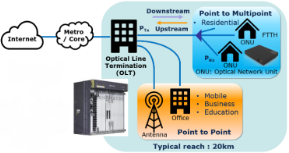
The use of optical amplification techniques as well as advanced photonic components are key elements to obtain state-of-the-art performance compatible with the existing infrastructure. The use of a multi-level amplitude (PAM) modulation format is studied within the framework of the bit rate increase for mobile networks. We demonstrate a real-time PAM‑4 100 Gbit/s/λ fiber access link in the O-band generated with an externally modulated laser chip (EML) composed of a monolithically integrated Distributed FeedBack laser and an Electro-Absorption Modulator (DFB-EAM). The modulation leads to an extinction ratio of 5.6 dB. This EML emits +3.5 dBm at 1309 nm after modulation and coupling in a microlensed fiber, and has an electro-optical -3 dB electro-optical (EO) BW of 46 GHz. The particularity of this work is that analog pre-equalization is used instead of digital signal processing (DSP) at the receiver as it is generally used in the literature, requiring digitization and parallelization of the detected signal. Fiber transmission of 20 km is realized with an optical budget of 30 dB which is compatible with existing infrastructure. We study the impact of the optical amplifier location in three configurations: booster, pre-amplifier, and both booster and pre-amplifier targeting point to point and point to multi-point scenarios both with fiber-based and semiconductor-based amplifiers.
These results demonstrate a way forward for bidirectional point to point standards.
Collaborations

Projets Financés
Lab’optic (laboratoire commun Orange, Institut Foton, LabStic)
Publications associées
- J. Potet, et al., “Real-Time DSP-Free 100 Gbit/s/λ PAM-4 Fiber Access Link Using EML and Direct Detection”, IEEE Photonics Technology Letters, vol. 34, iss. 17, pp. 895-898, (1 Sept.1, 2022), doi: 10.1109/LPT.2022.3191460.
- J. Potet et al., “Real-Time 100 Gbit/s/ λ PAM-4 Fiber Link supporting 4λ Operation with a Common Fiber Amplifier for Future Mobile X-haul and Point to Point Access Networks”, ECOC 2022.
- J. Potet et al., “Cross Gain Modulation Mitigation with Automatic Gain Control of Bidirectional SOA for DSP-free 50G-PON”, ECOC 2022.
- J. Potet et al., “Real -Time 400 Gbit/s PAM-4 Optical Link over 30 km for Future Access Network”, OFC, Th3G.1, 2023.