
⮞ Département SP ⮞ Thématiques de recherche⮞ Activités « Communications Optiques »
These research efforts focus on developing an innovative method to optimize the coefficients of an analog Feed-Forward Equalizer (FFE-ASP) for 50G-PON systems. The approach leverages a Minimum Mean Square Error (MMSE)-based Least Mean Squares (LMS) algorithm, addressing the challenge of identifying optimal equalizer settings in analog environments. This challenge is amplified by the vast number of possible coefficient combinations and the inherent imperfections of analog devices, such as bandwidth limitations and non-linear responses.
The work involves transmitting a 50 Gbit/s Non-Return-to-Zero (NRZ) electrical signal, which is filtered using a 13 GHz Bessel RF filter to replicate the constraints of low-cost components. A 6-tap FFE-ASP is employed for equalization, with each tap offering 255 discrete settings, creating a complex optimization scenario. The process begins by capturing the received signal and calculating impulse responses for each possible coefficient configuration. The FFE-ASP is modeled as a linear combination of normalized impulse responses, transforming the optimization into a Mean Squared Error (MSE) minimization problem. The Normalized LMS (NLMS) algorithm is then used to iteratively adjust the coefficients, minimizing the MSE between the input and output of the decision circuit.
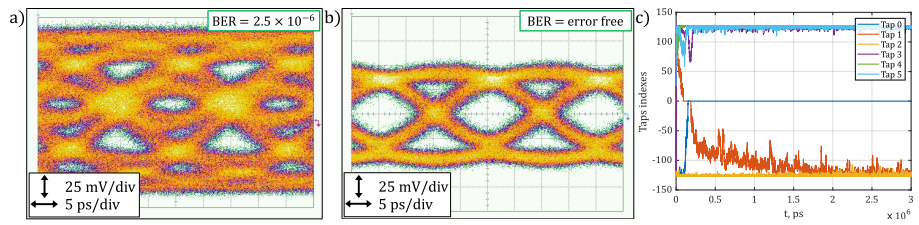
The results highlight significant improvements in signal quality. Initially, the Bit Error Rate (BER) stands at 2.5×10⁻⁶, with visible Inter-Symbol Interference (ISI) in the eye diagram. After optimization, the BER reaches error-free levels, and the eye diagram shows a fully opened eye, indicating effective ISI mitigation. The NLMS algorithm converges to the optimal coefficients in less than 1 microsecond, with tap indexes stabilizing near extreme values (±127), which correspond to high gain in the FFE-ASP filter.
This approach demonstrates that MMSE-based LMS optimization provides an effective solution for tuning analog FFE coefficients in 50G-PON systems. It not only enhances signal quality but also achieves this with lower energy consumption compared to digital alternatives, making it a promising technique for high-speed optical networks.
Collaborations

Projets Financés
- lab’optic : 2 thèses CIFRE : Dylan Chevalier 2022-2025 et Brendan Torillec 2025-
Contact: for the experimental implementation and for algorithm optimization.
Publications associées
D. Chevalier, P. Scalart, G. Simon, J. Potet, L. Bramerie, M. Joindot, M. Gay, P. Chanclou, and M. Thual, « Analog feedforward equalizer optimization in the context of 50G-PON, » J. Opt. Commun. Netw. 17, 401-411 (2025).
D. Chevalier, P. Scalart, G. Simon, L. Bramerie, M. Joindot, J. Potet, M. Gay, P. Chanclou, M. Thual, Impact of Analog FeedForward Equalizer Cells Initialization and Optimization in 50G-PON. Advanced Photonics Congress (IPR, Networks, NOMA, SOLITH, SPPCom) (2025), Jul 2025, Marseille, France. ⟨10.1364/sppcom.2025.spm3f.3⟩. ⟨hal-05266882⟩
D. Chevalier, L. Anet Neto, P. Scalart, G. Simon, L. Inglés, J. Potet, G. Gaillard, P. Chanclou, L. Bramerie, M. Joindot, M. Gay, M. Thual, Performances of Cost-Effective 50G ONU with Analog FFE and HI-FEC. Optical Fiber Communication Conference, 2025, San Francisco, France. pp.W1F.5, ⟨10.1364/OFC.2025.W1F.5⟩. ⟨hal-05122216⟩.
D. Chevalier, L. Anet Neto, G. Simon, P. Scalart, L. Inglés, J. Potet, P. Chanclou, L. Bramerie, M. Joindot, M. Gay, M. Thual, Digital vs Analog Equalization in FEC Supported 50G-PON, 2025 European Conference on Optical Communications (ECOC), 28 septembre-2 octobre 2025, Copenhagen (France). 1-4.. DOI: https://doi.org/10.1109/ECOC66593.2025.11263416. Réf. HAL: hal-05405699
D. Chevalier, P. Scalart, G. Simon, L. Bramerie, M. Joindot, et al., Analog FFE Coefficients Optimization Using MMSE-based LMS Algorithm in PON Context. Signal Processing in Photonic Communications (SPPCom), Jul 2024, Quebec, Canada. ⟨hal-04921880⟩