
⮞ Département SP ⮞ Thématiques de recherche⮞ Activités « Communications Optiques »
High-power optical amplification is a key requirement for future high-capacity Free-Space Optical (FSO) feeder links. In particular, GEO-to-ground links experience very high free-space losses, of about 290 dB over a 36,000 km distance, making the generation of very high optical power essential to close the link budget. However, operating optical amplifiers at such power levels raises new challenges related to nonlinear effects. Unlike conventional long-haul optical communication systems, where optical powers are relatively moderate and nonlinear impairments mainly accumulate over long transmission distances, FSO feeder links rely on very high optical powers over comparatively short distances. The nonlinear behaviour of optical amplifiers and fibres in this high-power regime is therefore less well understood, particularly when high-order modulation formats and WDM transmission are considered.
Our research addresses this challenge through complementary experimental and modelling approaches, combining the characterization of fibre nonlinearities, the investigation of nonlinear effects in very-high-power optical amplifiers, and the development of methods to predict their impact on high-capacity transmissions.
To address this challenge, we first developed a novel technique to directly measure the nonlinear coefficient of optical fibres using a coherent receiver. The method is based on the measurement of a three-wave phase shift generated by a sinusoidally modulated optical signal. It provides a simple and low-power approach to characterize the Kerr nonlinearity of optical fibres, with measurements in good agreement with the expected values for standard single-mode, dispersion-shifted and highly nonlinear fibres.
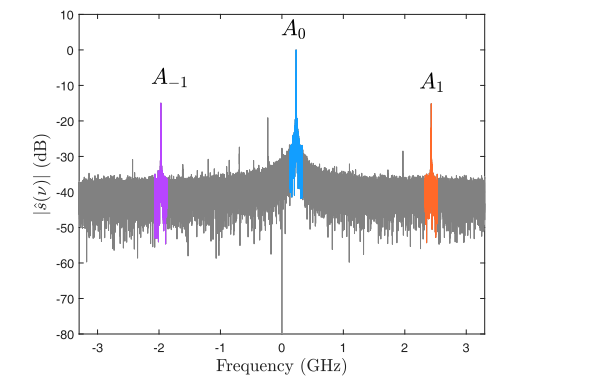
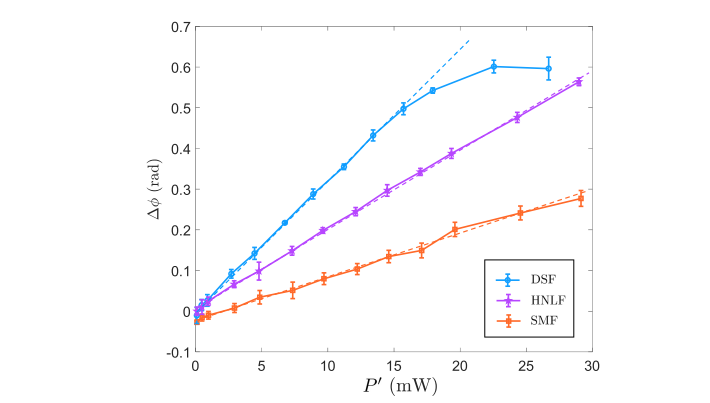
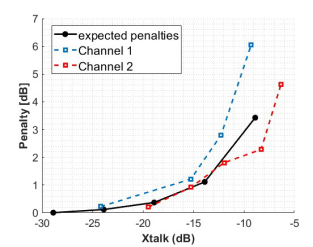
This experimental characterization provides the key parameters required to investigate nonlinear effects at the system level. In particular, the measured nonlinear properties of the optical medium can be used to quantify and predict the impact of Four-Wave Mixing (FWM) in WDM transmissions operated at very high optical power. A model based on the measured nonlinear characteristics was developed to estimate the resulting receiver sensitivity penalty, providing a first step towards the prediction and dimensioning of high-power WDM optical links.
Collaborations

Projets Financés
1 thèse CIFRE : Simon Lévêque 2024-2027
Contact: for experimental expertise and for nonlinear modelling.
Publications associées
Simon Lévêque, Mathilde Gay, Thierry Chartier, Anaëlle Maho, Michel Sotom, et al.. Assessing nonlinear effects in high–power optical amplifiers for WDM FSO communications up to 200 Gbps per channel. IEEE International Conference on Space Optical Systems and Applications, IEEE, Oct 2025, Kyoto, Japan. ⟨hal–05421498⟩
Laurent Bramerie, Mathilde Gay, Simon Lévêque, Anaelle Maho, Michel Joindot, et al.. A Novel Simple Technique to Measure the Nonlinear Coefficient of Optical Fibres Using a Coherent Receiver. 2025 Conference on Lasers and Electro–Optics Europe & European Quantum Electronics Conference (CLEO/Europe–EQEC), Jun 2025, Munich, Germany. pp.1–1, ⟨10.1109/cleo/europe–eqec65582.2025.11111670⟩. ⟨hal–05233276⟩
L. Bramerie, M. Gay, S. Leveque, A. Maho, M. Joindot, et al.. Measurement of the nonlinear coefficient of optical fibers using a coherent receiver. Optics Express, 2026, 34 (4), pp.6184–6204. ⟨10.1364/OE.579394⟩. ⟨hal–05598349⟩.