
⮞ Département SP ⮞ Thématiques de recherche ⮞ Activité « Optique Guidée et Capteurs » ⮞
Cross-cutting activities: Blue Photonics
The Photonic Systems (SP) team has extensive expertise in the development of miniaturized integrated photonic sensors for the detection of gases and liquids, particularly water pollutants. These sensors operate over a broad wavelength range, from the blue region to the mid-infrared, and address key societal challenges in the fields of environmental monitoring (BTEX, CO₂, CO, etc.), healthcare (volatile organic compounds, VOCs), and defence.
In recent years, the team’s research activities have contributed to:
- The development of integrated micro-resonators and photonic circuits based on polymers, porous silica and porous silicon. This includes the characterization of polymer micro-resonators for evanescent-wave sensing and porous silicon micro-resonators for bulk sensing. The team has experimentally demonstrated glucose concentration detection with state-of-the-art sensitivity, reaching up to 600 nm/RIU at 1550 nm.
- The experimental demonstration of the Vernier effect using an integrated micro-resonator embedded in each arm of a Mach–Zehnder interferometer fabricated from polymer materials. A sensor sensitivity of 17,558 nm/RIU was achieved, with an estimated detection limit of 4.6 × 10⁻⁷ RIU.
- The development of integrated photonic devices based on chalcogenide glasses for the near-infrared (NIR) and mid-infrared (MIR) spectral ranges. The team demonstrated evanescent-wave transduction for gas and liquid sensing in the mid-infrared using integrated photonic devices fabricated from chalcogenide glasses.
- The demonstration of bulk CO₂ sensing in the mid-infrared using integrated waveguides based on porous silicon, together with studies on the impact of partial oxidation of the material on sensing performance

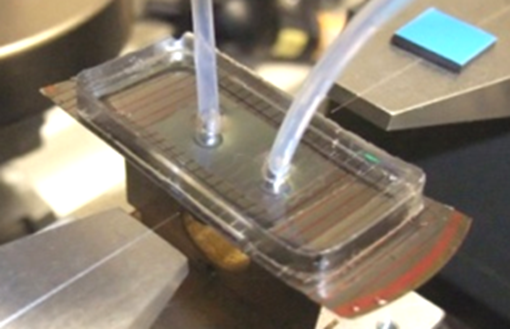
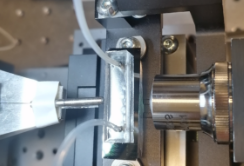
Examples of integrated photonics characterization setups, including a sample integrated with a microfluidic system.

Comparison of the sensitivity of bulk sensing and surface sensing (based on evanescent-wave detection) for glucose sensing. The sensitivity enhancement achieved using the Vernier effect for surface glucose detection is also illustrated.
Comparison of the sensitivity of bulk sensing and surface sensing (based on evanescent-wave detection) for glucose sensing. The sensitivity enhancement achieved using the Vernier effect for surface glucose detection is also illustrated:


Related Expertise and Facilities
- Design of integrated photonic components for optical sensing
- Multi-wavelength characterization platforms, covering wavelengths from the blue region to the mid-infrared
- Development of microfluidic cells
- Development of nano- and microfabrication technologies through the CCLO technological platform(link to the CCLO page)
Collaborations
- IEMN mettre les logos ou les liens après chaque partenaire
- Institut Fresnel
- ISCR
- IMMM
- Ifremer
- Klearia
- Damart
- MIRSENSE
- Argotech
- Vigo Photonics
Related Funded Projects
- ANR : Mid-VOC, AQUAE, POCOMA
- Projet européen IBAIA
- E-diamant
- PHC Maghreb
- Projet instrumentation CNRS
- CPER Sophie et BreizhPhot
Related Publications and Conferences
- Thèses soutenues : Paul, Pauline, Fabien, Aldo, Warda,
- Thèse en cours : Abdallah, Sofiane, Nouhaila, Sadok, Asma, Ronan